
Religion and Culture


Given that this is the first piece, it would make some sense to dwell for a bit on why we need to have a section on religion and culture in a blog that is confessedly to do with young people in India. It seems relatively uncontroversial to assert that a blog for young Indians should, ideally speaking, deal with issues that young Indians worry or think about. However, were we to draw a rough pie chart of what young people in India (alright for the sake of clarity and political correctness let me disambiguate this demography before I proceed– urban educated, English speaking, upper middle class Indians aged between 16 and 30) spend their days worrying about, I strongly suspect we would come to the conclusion that religion and culture occupy a very tiny piece of the pie- if they do occupy any space at all. Of course I am aware of the inherent dangers of deciding what the concerns of this blog should be on the basis of what young people in India spend their time thinking about- for if that were the sole deciding factor, this blog should immediately become a pornographic website and be done with it.  But even on those rare occasions that the mind of a young person turns to other issues, one finds that religion and culture figure miserably down the list of things that keep him or her awake at night. The question this piece will address itself to is: Why is this case?

Relying on that time tested scientific statistical tool called gut instinct – I am going to put forth two possible reasons that might explain this lack of interest. One is that the subject is useless and the other is that it is boring.

  1. It is useless:

On this allegation, there is not much to defend. In modern society, for any activity to be deemed ‘useful’, there only seem to be two benefits that count towards evaluating the activity. The potential that such activity provides for either making money or attracting mates.

It is pretty self evident that an intimate knowledge of the merits of the Jaipur- Atrauli Gharana is not going to make you very rich. In fact, statistically speaking, it is most certainly going to make you extremely poor. Nor is it going to be a clincher on your first date. It could be possibly ruinous to any romantic potential if you break out into a noisy throaty exploration of the peaks and depths of Raag Marwa during dinner. Not cool.

We have to agree. It is almost completely ‘useless’ in this sense.

2. It is boring:

    On this allegation, we do have something to say.

    Let’s admit it, there are very few people who will be turned on by the below passage:[1]

    Some indeed define the term ‘superimposition’ as the superimposition of the attributes of one thing on another thing. Others, again, define superimposition as the error founded on the non-apprehension of the difference of that which is superimposed from that on which it is superimposed. Others, again, define it as the fictitious assumption of attributes contrary to the nature of that thing on which something else is superimposed. But all these definitions agree in so far as they represent superimposition as the apparent presentation of the attributes of one thing in another thing. And therewith agrees also the popular view which is exemplified by expressions such as the following: ‘Mother-of-pearl appears like silver,’ ‘The moon although one only appears as if she were double.’ But how is it possible that on the interior Self which itself is not an object there should be superimposed objects and their attributes? For every one superimposes an object only on such other objects as are placed before him (i.e. in contact with his sense-organs), and you have said before that the interior Self which is entirely disconnected from the idea of the Thou (the Non-Ego) is never an object. It is not, we reply, non-object in the absolute sense. For it is the object of the notion of the Ego, and the interior Self is well known to exist on account of its immediate (intuitive) presentation. Nor is it an exceptionless rule that objects can be superimposed only on such other objects as are before us, i.e. in contact with our sense-organs; for non-discerning men superimpose on the ether, which is not the object of sensuous perception, dark-blue colour.

    Hence it follows that the assumption of the Non-Self being superimposed on the interior Self is not unreasonable.

    The quote is from the Brahmasutra Bhasya by Adi Sankara, considered one of the greatest accomplishments of Indian Philosophy. It is impressive if you did not yawn more than five times while reading that.

    The previous passage notwithstanding, this allegation – that Indian religion and culture is boring – we feel is entirely misplaced and unjustified. For those who persist there is reward. The body may be pleased easily but the spirit is more demanding. Anything that is a source of lasting engagement and pleasure is always daunting at first and a little boring at the beginning. It would be almost impossible to completely or universally demonstrate that Indian religion and culture as pursuits are not boring. This is because boredom is the most subjective experience that human kind is cursed to undergo. However, we believe, with a couple of illustrations we can possibly throw some light on what a fascinating and engaging subject it really is. Illustrations that will of their own, kindle the interest, whet the appetite and convince a section of readers that this is possibly the most fascinating of all subjects areas that this blog concerns itself with.

    1. Gauhar Jan:

    Read the below extract from the biography of Gauhar Jan. She was one of the first performers to record music on 78 rpm records in India. You can also listen to her voice here for some flavour:

    http://www.youtube.com/watch?v=SWuuHdf0ssg&NR=1

    “Gauhar Jaan was born as Angelina Yeoward in 1873 in Patna, of Armenian descent. Her father, William Robert Yeoward, worked as an engineer in a dry ice factory at Azamgarh, near Banaras, and married her mother, Allen Victoria Hemming, around 1870. Victoria was born and brought up in India, and trained in music and dance.

    Within a few years in 1879, the marriage ended, causing hardships to both mother and daughter, who later migrated to Benaras in 1881, with a Muslim nobleman, ‘Khursheed’, who appreciated Victoria’s music more than her husband.

    Later, Victoria, converted to Islam and changed Angelina’s name to ‘Gauhar Jaan’ and hers to ‘Malka Jaan’….”[2]

    The mind boggles at the life that an Aremnian Jew, married to an Indian Muslim in Benaras in the 1800’s learning Indian Classical music as a courtesan would have led. It must have been incomparably complicated and rich and the story becomes all the more striking and personal when you listen to the voice.

    2. Sándor Kőrösi Csoma

      Sándor Kőrösi Csoma (March 27, 1784– April 11, 1842), born Csoma Sándor, also known as Alexander Csoma de Kőrös, was a Hungarian philologist and orientalist, author of the first Tibetan-English dictionary and grammar book. He was born in Kőrös, Transylvania.

      Hoping that he would be able to trace the origin of the Magyar ethnic group, he set out for the East in 1820, and after much hardship along the way, arrived in Ladakh. Under great privation there, despite being aided by the British government, he devoted himself to the study of the Tibetan language. He made the first English-Tibetian Dictionary while living at Zangla Monastery in Zanskar in 1823. The dictionary was published a year later in 1824

      In 1831, he settled in Calcutta, where he compiled his Tibetan Grammar and Dictionary and catalogued the Tibetan works in the library of the Asiatic Society. He died in Darjeeling just as he was setting out for fresh discoveries. He is said to have been able to read in seventeen languages. De Kőrös is widely seen as the founder of Tibetology….”[3]

      Going to Ladakh now in 2010 seems to be an adventure. Imagine a Hungarian Scholar walking to Ladakh and there being so impressed with the Tibetan language and culture so as to spend his entire life engaged in analyzing it. It says something about the sincerity with which people used to approach their vocations.

      Indian culture, music, religion, philosophy, literature and poetry abound with personalities and people like Gauhar Jan and Alexander Csoma de Kőrös. People who above all valued the expression of the deepest yearnings of their spirit. People who have led immeasurably colorful lives. We hope to share with our readers some of these exciting personalities and their stories. We would consider ourselves successful if we convince even a minute section of our readership that Indian culture and religion are far from boring.


      [1] For that strange specie of readers who actually want to read the entire thing: http://www.bharatadesam.com/spiritual/brahma_sutra/brahma_sutra_sankara_index.php

      [2] For  the remaining biography: http://en.wikipedia.org/wiki/Gauhar_Jan

      [3] For  the remaining biography: http://en.wikipedia.org/wiki/Alexander_Csoma_de_K%C5%91r%C3%B6s
      Posted in Philosophy, Religion & Culture | Tagged , , , | 2 Comments

      Miscellaneous Day Part I

      (This piece of “fact”-ion is based on an average miscellaneous day for an average junior. Any resemblance to persons living, dead or undead is probably coincidental and maybe unintentional… unless they are undead in which case we offer our humble apologies to our Zombie Overlords)

      So you think you’re too good for the law firm. You’ve turned down offers with a snort of derision and an email, barely hiding your contempt for the corporate law world. The grime and dirt of litigation in the lower courts are way beneath you and you shudder at the thought of being in a classroom again, so teaching’s out of the question. You think you can tell the difference between the doctrine of legitimate expectation and promissory estoppel (better than the Supreme Court for that matter). So the only career option for you is the highest of the high, the most important of the most important-est, the Supreme Court of India itself. Naturally, since you just finished law, you’ve got to start at the lowest level at the highest level… junior to Senior Advocate.

      So you join a Senior who actually pays cold hard cash (in the form of tax deducted cheques every month) for your “services”. Your “services”, you will realize very quickly, involve following him around on Miscellaneous Day in the Supreme Court; Monday and Friday every week.

      Hah, miscellaneous day, you think. Been there and done that, you tell yourself like an old pro. In fact the sum total of your experience of miscellaneous day has been the naps you took in the visitor’s gallery in the various courtrooms while you interned with another Senior. It was mostly fun too, watching lawyers of all shapes, sizes, accents, stages of hair loss and sense of self importance attempt to convince judges in 2 minutes or less, the need to admit their particular case for further scrutiny. That didn’t seem so hard. Or complicated. This seems like a particularly easy piece of lemon cheesecake with soft icing and a cherry on to… ahem. Very easy. Yes.

      On your first Saturday in Delhi you see the Qutb Minar… on your desk. Except it turns out to be the pile of matters for Monday. Prepare notes on everything by tomorrow and be ready with all the facts. By tomo. This is an unusual miscellaneous day right? I mean not every weekend is gone thanks to miscellaneous day, right? The more “experienced” juniors titter among themselves and give each other knowing smiles and just as you’re wondering what intra-office sexual innuendo you’re missing out on, one of them helpfully clarifies that this is every miscellaneous day…. Ever.

      As you cry silent tears for your weekends lost, and work your way through the pile of poorly drafted SLPs, you console yourself with the fact that at least, this is “real” lawyering work. At least you’re using legal skills and not just your proficiency at Microsoft Word 2007 ™.

      You spend the weekend on carefully crafted and well researched notes. On Sunday evening as you help your boss prepare for Monday, there comes a crushing realization. All your notes are entirely useless. Your boss has his own notes. Handed written with all the citations in his own short hand. You make yourself marginally useful by picking up the cases from the office library for tomorrow.

      On the day itself, you feel all important and lawyerly in your lawyer robes, stride confidently into the Supreme Court… and join the long, long queue of lawyers waiting for a photo-identity pass. By the time you fill out the form and wait for your turn to come, you sport the dirtiest look and it shows on your pass. The poor light and low resolution webcam make you look like more like a convicted criminal and less like the appellate court litigator you imagine yourself to be. You stand in line again at the gate and quietly curse the lucky few who managed to get the proximity card before the SCBA’s internecine warfare put a sudden end to the process. You’ve got a mentioning matter in Court 1 and it is 10:29:45 already.

      You rush into court 1… and get shoved right out. There’s a solid wall of black blocking your way. Lawyers jammed in tight into the passage leading upto the Bar. To the sane and rational mind, there is no way in. But this is Miscellaneous Day. Sanity and rationality were stopped outside the court for not having proximity cards. You adopt the path of least resistance and most privacy invasive. You start by identifying the tiniest gaps, non-obvious to all but the most discerning eye, and like a particularly skilful octopus, insert yourself into these gaps. Soon, enough of you is trapped between the bodies and gowns, and the natural churning and movements of human bodies trapped in an enclosed space sees you getting spat out somewhere in the direction of the Bar. Mentioning has begun and you barely catch enough breath to mention your matter, and turn around to repeat the process, only this time trying to get out of the court. Before you know it (no, actually it’s like a particularly tortuous eon, but you want to block it out of your mind) you’re in the corridor, all ready and set to begin the Miscellaneous Day Run. 14 matters, 11 courts… all likely to reach at approximately the same time. So it begins.

      Two matters down and you’re gasping for breath and losing liquid mass faster than an icecube in the Thar. You run to the cafeteria, toss money in the general direction of the cashier, grab bottles of water and chug them down as you hustle off to Court with renewed vigour to the next matter.

      The clerk’s there, outside court. Evidently looking for you. He tells you what you don’t want to hear. Pass-over lena padega. Saab high court gaya. You groan. Not this matter, not this court, not this judge. Once more you contort yourself, intercept others’ sneezes and coughs in the process and finally land up close to the Bar, just as your matter is being called out. “Passover” you gasp, hoping that the judge is too overworked, harassed or just too annoyed to bother you with further questioning.

      Or he could just be too overworked, harassed or just too annoyed to indulge the juniors of over paid senior counsel. Shit.

      He glares at you, narrows his eyes, and says the one thing you did not want to hear.

      “Why?”

      (to be continued)

      Posted in Law & The Judiciary | Tagged , , , , , , , | Leave a comment

      The Social Life of Radiation

      2010 ought to have marked a watershed in our collective understanding of nuclearisation in India. The death of Rajendra Prasad, a scrap-metal worker in Delhi, was the first time since 1998 that the national mass media carried sustained coverage about nuclear radiation and its effects. An astounding fact for a nation that claims to be the world’s new, democratic, nuclear power.

      Prasad was a scrapyard worker in the Mayapuri market who happened to be in a group that broke open a piece of equipment in search of metal. At its core was an unfamiliar substance which was handed over to the scrapyard owner. The latter, unsure of its worth, stored it away. Very soon, however, they were all to be among 8 people who were hospitalised, at least 6 of them for over 20 days. Prasad died an agonising death through multiple organ failure at the end of that time.

      Too important to be public

      The ignorance of Prasad and his co-workers reveals one of the key aspects of the social base of Indian democracy. The careful insulation of certain elements of state policy from any public life at all. In the 12 years since India has tested nuclear weapons, there is shockingly little sense that Indians as a whole have grown more aware of the ramifications of nuclearisation.

      Successive governments have chosen to talk about nuclear issues in one of two ways. They are presented either as having ‘raised’ India’s profile to that of a superpower or as a success of our home-grown scientific establishment. Apart from these two celebratory chords the, Indian nuclear legitimation sitar has also predictably maintained a more doleful drone about regional (read Pakistani) threats. We are told that we are now a great power to be taken seriously and that we have (successfully) tested a range of missiles and other nuclear-capable vehicles. Along the way, at least one Defence minister has reminded all of us on the subcontinent that India could, “take a bomb or two more but when we respond there will be no Pakistan.” In this endeavour, the media too has danced faithfully to the alternately celebratory and alarmist cadences of the state. All of this ‘hardheaded’ (a favourite adjective) and ‘mature’ talk is designed to make us leave nuclear issues to the experts and not identify them as a legitimate arena for social questioning.

      Even more chilling, however, than the success of what the state has been able to speak, is what it has been able to stay silent about. One of the most significant of these silences has been about the question of radiation. The aplomb with which the citizenry of a nuclear-capable nation in the midst of an ongoing arms race is able to think of nuclear weapons as just a bigger version of a conventional bomb, is truly remarkable. This is the really big success of the nuclear establishment of India – its ability to obscure the inherent moral evil of nuclear weapons and nuclear deterrence. The silence on the effects of radiation is just one aspect of this much larger diversion.

      Inequality and Radiation

      But Prasad’s death also laid bare another aspect of the social life of radiation in India. Though it is deemed worthy of discussion and direction only among the elite, its victims have invariably been among the poor. The state of affairs in communities around power plants in Rawatbhata and mining activities in Jharkhand has been swept under the carpet for many years. A study conducted by the Indian Doctors for Peace and Development in 2007 found that the rates of cancer, miscarriages, stillbirths and congenital deformations in the vicinity of the Jaduguda uranium mines are each well above what was found in control villages 30 kms away. The cause is persistent exposure to low-grade radiation as a result of the worst uranium mining practices anywhere in the world. As the scientist M.V. Ramana has pointed out, workers in Indian nuclear power plants have also been routinely exposed to higher-than permitted doses of radiation during the course of work.1 There are people whose lives have been tragically affected and even cut-short by radiation. Yet, the atomic establishment has consistently refused to conduct baseline studies of health in areas surrounding new facilities that it has proposed, or to commission independent studies of radiation effects around existing ones. The fact that it took an event in Delhi to put radiation into the national imagination reveals much about inequalities in India.

      The nuclear establishment in India has over the entire course of its existence been unaccountable, secretive and inefficient. The fact that it is able to continue to do so is testament to the fundamentally un-democratic nature of the nuclear establishment in its conjoined military and civil avatars. As Itty Abraham has pointed out, part of the reason for this is the historical construction of the nuclear public sphere as the exclusive domain of a narrow strategic community.2 In this, nuclear discourse represents the distilled essence of the undemocratic strands of the Indian polity, with almost none of the mitigating freedoms that are visible in other arenas. A more aware and engaged “atomic public”, however, is necessary if the subcontinent is to avoid being the site of the next nuclear nightmare.

      1 http://www.environmentportal.in/files/Kaiga%20and%20Other%20Nuclear%20Stories.pdf

      2Itty Abraham, South Asian Cultures of the Bomb

      Posted in Economic & Social Policy | Tagged , | 1 Comment

      L.S.D. and the Great Indian Middle Class in the Films of Dibakar Banerjee

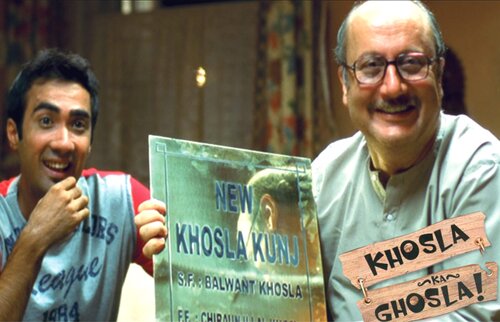
      Anupam Kher showing the golden name plate in Khosla Ka Ghosla.

      Part I: Before the Shock came the Smiles

      Before making Love, Sex aur Dhoka (Love, Sex and Betrayal or LSD for short), Dibakar Banerjee had made two of the most original and authentic movies of the so called new generation of Bollywood since the turn of the millennium. His first movie Khosla ka Ghosla (Khosla’s Nest or KKG for short) was and continues to be arguably the best comedy about a post liberalization middle class family. The closest resemblance that it had was to the movies of Hrishikesh Mukherjee about simple and gentle middle class families in the India of 1970s/80s, so comfortably insulated from the chaos of their political and social settings that they could indulge in their funny and often whimsical ‘problems’. Khosla ka Ghosla however, went much further than being a comic tale of a middle class family. It dealt with the hilarious consequences when two seemingly disparate worlds interact with each other as they do quite invariably in our modern India. The sophisticated have to interact with the crude and the gentle law abiders have to deal with the gun totters. In a way, it was also a subtle ‘critique’ of how the middle class likes to isolate itself from the muck around it and how frail and short lasting these attempts are.

      Some of the best parts of the movie, however, were the interactions between the pre and post liberalization generations represented by a father and his son. The father played brilliantly by Anupam Kher is driven by the middle class dream of his generation: a good, self owned house. The son also seems to be driven by the middle class dream of his own generation that of getting a job in the US. Neither of them understands the value of what the other values. The new post liberalization generation is typified by a confidence of economic self sufficiency which the prior generation did not have till very late in their lives. This also means that the attempts of the older generation to exercise control over the young one can no longer gain strength from ‘zaaydaad se bedkhal’ (dis-entitlement from the family property) threats that were so common in the movies of 70s and 80s. Instead, the older generation tries to adapt by trying to appease and cajole the younger generation which results in some really funny and yet somewhere heart warming scenes in Khosla ka Ghosla. One of them being where the presumably teetotaler father gets whisky at home to drink with his son or the one where understanding that Chiraujni Lal is a particularly embarrassing name for his son, he suggests changing it to CL Khosla. “Same ka same aur different ka different”

      If Khosla Ka Ghosla established his credentials as a sensible and crafted filmmaker, Banerjee’s second movie, Oye Lucky! Lucky Oye! (OL, LO) convinced everyone how good his understanding of the urban middle class sensibilities is. The protagonist (Lucky) in OL,LO is seen in his earlier years as a very normal teenager who lusts after the same attractive things and has the same insecurities that other young people of his age and background have. Of course, he grows up to be a master thief which is not something that ‘regular’ middle class boys do for a living. However, unlike the movies of the 70s and 80s the explanation behind him becoming a thief is not rooted in some great personal tragedy or the prospect of starvation in the face of a cruel, classist world but rather in his middle class desire to be upwardly mobile.

      He steals because he wants the good things in life and after a point perhaps because he just loves his work and loves the fact that he is so good at it.  There is a very interesting montage in the movie, when Lucky being frustrated and disturbed by the fraud pulled on him by Paresh Rawal’s character, goes on a spree stealing everything and anything that comes across his way, all through the night. One of the biggest reasons for the success of Lucky (and the real life character on whom he is supposedly based) seemed to be that he did not appear to be the stereotypical criminal, the uneducated, filthy and crass thug.  He would dress well, drive a flashy car (stolen, of course) and appear to be suave and cultured. In short, to the upper middle class of south Delhi, he would appear to be ‘one of them’.

      Dibakar does a reversal of sorts in the relationship of the classes in KGK and OL, LO. While in Khosla Ka Ghosla, the crude, loud, uneducated Boman Irani is the exploiter and a gentle, educated, mild mannered Anupam Kher suffers him, in OL,LO, our smart, daring and super successful hero who fools the filthy rich and the helpless police with equal ease is, in fact conned by the sophisticated, educated and supposedly respectful veterinarian played by Paresh Rawal.

      The father-son relationship is at the core of both KKG and OL, LO. The actions of the protagonist in both the movies are driven by their relationship with their fathers. In Khosla ka Ghosla, the son (played by Parvin Dabas) does not want to lead the embarrassing and outdated life that his father has planned for him but when he sees how helpless his father is against the corrupt and terrorizing Boman Irani, he devices a plan to get the plot back for him. In OL, LO, Lucky is continuously looking for a father figure (played every time by Paresh Rawal) and is disappointed every time. This supposedly fuels up his hunger for fame and his disregard for the authority and rules of a society which is equally disregardful of his existence.

      Having made these two light hearted and yet realistic and sensible movies, everyone was looking forward to Dibakar’s new project and almost everyone expected that it would have the same nice, quiet and peaceful general tone even though it was audaciously titled Love, Sex aur Dhoka. When the movie came out a sizable number of people who went expecting a light hearted or a titillating film were disappointed to put it mildly (I had the good fortune of watching the movie with some of them who went on abusing the family of the director and how the movie was a Dhoka (fraud) upon them, the poor popcorn munching audience). The ‘critics’ and a hundred other serious film-goers were impressed to a great extent but shocked to a greater extent.


      (THIS IS THE FIRST PART OF A TWO PART SERIES)

      <!–[if !mso]> <! st1\:*{behavior:url(#ieooui) } –>

      Part I: Before the Shock came the Smiles

      Before making Love, Sex aur Dhoka (Love, Sex and Betrayal or LSD for short), Dibakar Banerjee had made two of the most original and authentic movies of the so called new generation of Bollywood since the turn of the millennium. His first movie Khosla ka Ghosla (Khosla’s Nest or KKG for short) was and continues to be arguably the best comedy about a post liberalization middle class family. The closest resemblance that it had was to the movies of Hrishikesh Mukherjee about simple and gentle middle class families in the India of 1970s/80s, so comfortably insulated from the chaos of their political and social settings that they could indulge in their funny and often whimsical ‘problems’. Khosla ka Ghosla however, went much further than being a comic tale of a middle class family. It dealt with the hilarious consequences when two seemingly disparate worlds interact with each other as they do quite invariably in our modern India. The sophisticated have to interact with the crude and the gentle law abiders have to deal with the gun totters. In a way, it was also a subtle ‘critique’ of how the middle class likes to isolate itself from the muck around it and how frail and short lasting these attempts are.

      Some of the best parts of the movie, however, were the interactions between the pre and post liberalization generations represented by a father and his son. The father played brilliantly by Anupam Kher is driven by the middle class dream of his generation: a good, self owned house. The son also seems to be driven by the middle class dream of his own generation that of getting a job in the US. Neither of them understands the value of what the other values. The new post liberalization generation is typified by a confidence of economic self sufficiency which the prior generation did not have till very late in their lives. This also means that the attempts of the older generation to exercise control over the young one can no longer gain strength from ‘zaaydaad se bedkhal’ (dis-entitlement from the family property) threats that were so common in the movies of 70s and 80s. Instead, the older generation tries to adapt by trying to appease and cajole the younger generation which results in some really funny and yet somewhere heart warming scenes in Khosla ka Ghosla. One of them being where the presumably teetotaler father gets whisky at home to drink with his son or the one where understanding that Chiraujni Lal is a particularly embarrassing name for his son, he suggests changing it to CL Khosla. “Same ka same aur different ka different”

      If Khosla Ka Ghosla established his credentials as a sensible and crafted filmmaker, Banerjee’s second movie, Oye Lucky! Lucky Oye! (OL, LO) convinced everyone how good his understanding of the urban middle class sensibilities is. The protagonist (Lucky) in OL,LO is seen in his earlier years as a very normal teenager who lusts after the same attractive things and has the same insecurities that other young people of his age and background have. Of course, he grows up to be a master thief which is not something that ‘regular’ middle class boys do for a living. However, unlike the movies of the 70s and 80s the explanation behind him becoming a thief is not rooted in some great personal tragedy or the prospect of starvation in the face of a cruel, classist world but rather in his middle class desire to be upwardly mobile.

      He steals because he wants the good things in life and after a point perhaps because he just loves his work and loves the fact that he is so good at it.  There is a very interesting montage in the movie, when Lucky being frustrated and disturbed by the fraud pulled on him by Paresh Rawal’s character, goes on a spree stealing everything and anything that comes across his way, all through the night. One of the biggest reasons for the success of Lucky (and the real life character on whom he is supposedly based) seemed to be that he did not appear to be the stereotypical criminal, the uneducated, filthy and crass thug.  He would dress well, drive a flashy car (stolen, of course) and appear to be suave and cultured. In short, to the upper middle class of south Delhi, he would appear to be ‘one of them’.

      Dibakar does a reversal of sorts in the relationship of the classes in KGK and OL, LO. While in Khosla Ka Ghosla, the crude, loud, uneducated Boman Irani is the exploiter and a gentle, educated, mild mannered Anupam Kher suffers him, in OL,LO, our smart, daring and super successful hero who fools the filthy rich and the helpless police with equal ease is, in fact conned by the sophisticated, educated and supposedly respectful veterinarian played by Paresh Rawal.

      The father-son relationship is at the core of both KKG and OL, LO. The actions of the protagonist in both the movies are driven by their relationship with their fathers. In Khosla ka Ghosla, the son (played by Parvin Dabas) does not want to lead the embarrassing and outdated life that his father has planned for him but when he sees how helpless his father is against the corrupt and terrorizing Boman Irani, he devices a plan to get the plot back for him. In OL, LO, Lucky is continuously looking for a father figure (played every time by Paresh Rawal) and is disappointed every time. This supposedly fuels up his hunger for fame and his disregard for the authority and rules of a society which is equally disregardful of his existence.

      Having made these two light hearted and yet realistic and sensible movies, everyone was looking forward to Dibakar’s new project and almost everyone expected that it would have the same nice, quiet and peaceful general tone even though it was audaciously titled Love, Sex aur Dhoka. When the movie came out a sizable number of people who went expecting a light hearted or a titillating film were disappointed to put it mildly (I had the good fortune of watching the movie with some of them who went on abusing the family of the director and how the movie was a Dhoka (fraud) upon them, the poor popcorn munching audience). The ‘critics’ and a hundred other serious film-goers were impressed to a great extent but shocked to a greater extent.


      (This IS THE FIRST PART OF A TWO PART SERIES)

      Posted in Media & Popular Culture | Tagged , | Leave a comment

      Federer’s Fall

      As he sunk to a crushing defeat against Tomas Berdych in the quarter-finals of the Wimbledon Championships earlier this year, I wondered if Roger Federer’s aura had dissipated to the extent that unqualified greatness would perhaps evade him. Statistically, Federer stands at the summit of tennis. Sixteen Grand-Slam triumphs, including a victory at each of the majors, place him at the highest of roosts, but his inferior head-to-head record against Rafael Nadal, his greatest rival, coupled with the Spaniard’s growing prominence put not only his records, but also the contentious ‘greatest of all time’ tag at peril.

      Sport, Simon Barnes, a former chief sportswriter of the Times, says, “is all about greatness: the search for greatness, the falling short from greatness, the rare, rare achievement of greatness.” A definition of greatness is however, ever elusive. There are no clearly delineated criteria to identify greatness and any analysis on those lines is rarely objective. Yet, people argue that Federer is the greatest tennis player to have drawn breath.

      Popular wisdom, presumably, would make us look first at the numbers. There Federer is nearly peerless. In lifting the French Open in 2009, he not only equalled Pete Sampras’s tally of 14 Grand Slam triumphs, but also became only the third player in the Open Era to own all four majors. Since then, he has gone on to lift his sixth Wimbledon title in 2009 and his fourth Australian Open in 2010. It is also astounding that Federer’s 16 triumphs have come in the span of a mere 29 tournaments, while Sampras’s 14 titles were achieved over 49 majors. Grand Slams aside, the Swiss has won 62 titles and has raked up prize-money in excess of U.S. $ 55 million. The statistics are so mind-boggling that some have argued that Federer is not merely the greatest tennis player, but that he also possesses a good claim to being the greatest exponent of any sport in history.

      It must, however, be said that statistics are a tricky indicator of greatness. Is Federer’s dominant record indicative of his own pre-eminence or is it merely a product of the mediocrity of his opponents? Can it be convincingly argued that Federer would have defeated Rod Laver, Bjorn Borg, John McEnroe, Jimmy Connors or Pete Sampras, when they were in their pomp? There are no answers to these questions and there lies the contradiction in a study that describes a person as the greatest of all time.

      Even otherwise, the argument must not end in numbers that merely showcase Federer’s overall records. In any debate on greatness, the head-to-head record against rivals becomes a crucial consideration. While Federer has been terrifically dominant against Andy Roddick (19-2), Marat Safin (9-2) and Lleyton Hewitt (17-9), his main challengers in the early phase of his career, he has won only a paltry seven times in twenty-one matches against Rafael Nadal, presently his chief competitor. Although he has lost only five times in fourteen meetings to Novak Djokovic, he has been overcome six times in eleven outings by Andy Murray; records, which suggest that he has not merely struggled occasionally, but that he has come-a-cropper on numerous occasions against his most formidable rivals. It must however, be noted that an analysis on these lines can be deceptive, for a player could have dominated a specific opponent in Grand Slams, where it really matters and could have failed in inconsequential events. But the fact that Federer has lost to Nadal in five out of seven Grand Slam finals, indicates that Federer may not even be the greatest of his own generation, thereby making the argument that he is the greatest of all time, practically preposterous.

      It is therefore, time to leave the debate on greatness aside and marvel at the gorgeous gifts that Federer is endowed with. His transformation from a precocious, yet cantankerous teenager to a player of sublime skill and serene disposition has been quite remarkable. After quarter-final appearances at the French Open and at Wimbledon in 2001, with the latter involving a triumph against Sampras, regarded by many as a change-of-guard of sorts, Federer won his first Grand Slam, quite fittingly, at Wimbledon in 2003. A straight sets defeat of Mark Philippoussis in the final, splendid in both its elegance and its ruthlessness, was a sign of things to come.

      Wimbledon has always held a cherished place in Federer’s heart; he has reserved most of his best tennis for the holy grass, winning six times in all, only one short of Sampras’s haul. With the grass slowing down in recent years, players have tended to play from the baseline; a phenomenon that has suited Federer, whose nimble feet has made his movement a joy to behold. Over the years he has showcased an extraordinary mastery of the geometry of a tennis court, managing to create strokes, particularly on his forehand of terrific angular precision; the tennis racquet has at times looked more akin to a magic wand in his hands.

      The backhand however, it must be said, has never been his strong suit – it has taken him years of toil it to turn into a force of reasonable strength. Excellent on the volley and on overheads, off both wings, Federer is at ease when at the net, but it is his serve that represents the most underrated aspect of his game. It may not be particularly speedy, but possessing the ability to vary it in myriad ways and to produce astonishing angles, he has turned it into a weapon of substance.

      A fourth round defeat in the U.S. Open in 2003 was only a blip, as the following year saw Federer lift three out of the four Grand Slams, with only the French Open proving the proverbial Achilles heal. The Australian Open marked a seminal moment in his career. Not only did he dismantle Marat Safin, arguably the most talented of the generation, in straight sets in the final, it marked the first of twenty-three consecutive appearances that he made in Grand Slam semi-finals, indicative of his extraordinary consistency. At the French Open, he lost to Rafael Nadal in the semi-finals, an opponent to whom he’d lose in three consecutive finals between 2005 and 2008. The year however, saw Federer also claim the title at Wimbledon, the second of his five consecutive and six total triumphs at SW-19, and the U.S. Open, the second of his five consecutive victories at Flushing Meadows.

      Between 2004 and 2008, Federer dominated tennis like never before. In the eyes of many though, it was his victory at the French Open in 2009 that established Federer’s superiority over tennis players across generations.

      “This could be my biggest victory, the one that takes off the most pressure,” said Federer, who was in tears, not for the first or last time, after the 6-1, 7-6 (1), 6-4 victory over Robin Soderling, then an unheralded Swede, in the final. “Now for the rest of my career, I can play relaxed and never hear again that I never won the French Open.”  There were sceptics who felt that the fact that Nadal, himself a victim of Soderling, was not standing in Federer’s way diminished the triumph in some ways. This however, is quite irrelevant. The nature of a Grand Slam is such that the last man standing has more than a worthy claim to victory and Federer’s success may not have been the most memorable, for he himself may have preferred to defeat Nadal, but it nonetheless qualifies as an outstanding achievement. Had Nadal been injured or had he withdrawn from the tournament for any reason, the argument that Federer’s victory was soured may still have stood. But as it stands, Federer’s victory at Rolland Garros saw him join an elite band of five who had won the singles title at all of the Grand Slams; Don Budge, Fred Perry, Roy Emerson, Rod Laver and Andre Agassi, with only Laver and Agassi having achieved the feat in the open era and with only Laver having won all the Grand Slams in a single calendar year (a feat that the Australian managed twice, once as an amateur and once in the Open Era).

      Federer has been a more than competent clay court player and his forays at Roland Garros had up until then been brought to a grinding halt only due to the superiority of Nadal and not due to any perceptible weakness in his own game. By reaching four finals at Paris, including the triumph in 2009, Federer has exhibited an ability to play on all surfaces, a virtue hugely indicative of his overall brilliance.

      Immediately after his victory at the French Open, he briefly played as if the shackles had been unleashed, romping to a sixth Wimbledon title; albeit one achieved after a 16-14 final set score against Andy Roddick in the final. However, he did lose in the final of the U.S. Open to Juan Martín del Potro, a tall Argentinean with a style not too dissimilar to that of Robin Soderling and Tomas Berdych, an aspect, which I’ll discuss later. These may have been early signs of a weakness in Federer’s game, but with Nadal plagued by tendonitis in his knee, it seemed that there wouldn’t be an answer to his matchlessness.

      Federer started 2010 with a storm, displaying a rare concoction of brutality and beauty, in dismissing Andy Murray in three easy sets in the final to lift his 16th Grand Slam title. Murray held the superior record against the Swiss going into the final, but Federer at times lifted his game to dizzying heights of brilliance. Serving like a dream and walloping his forehand with precision of both timing and accuracy, he quelled Murray’s threat with an exhibition of tennis that was as exceptional as it was gorgeous. I have felt in the past that the grace in Federer’s game is at times overstated. He does make tennis look ridiculously easy at times, but that, I felt was being confused for elegance. In the final at Melbourne, though, I was for the first time convinced of the beauty in his game. Even the backhand, not his most natural stroke, was being struck to perfection with an artistic flourish.

      It was only six months ago that Federer seemed invincible; marching on endlessly, it appeared, to goals that he himself may have been oblivious to. But six months is often a long time in sport. Berdych’s victory in the quarter-finals at Wimbledon may not represent as seminal a moment as Federer’s own triumph over Sampras in 2001, but nonetheless the manner of the loss left a feeling that we may never see Federer at his best again.

      Leading up to Wimbledon, Federer had had his travails, losing first in the quarterfinals of the French Open to Soderling and then to Hewitt in the grass courts at Halle, with the former ending his phenomenal streak of twenty-three consecutive appearances in Grand Slam semi-finals. Having failed to win a tournament since he lifted the Australian Open, the loss at Wimbledon did not come as a particular surprise, but the fashion of his submission told a separate tale.

      Admittedly, Federer had his moments against Berdych; especially in the second set which he grabbed 6-3 when he unveiled strokes of emblematic grace and precision. But as the game progressed, he wilted under the pressure produced by the sheer ferocity of the Czech’s ground-strokes. Berdych has for long been considered a fine talent, one who was touted to belong to a new aggregation of stars alongside Andy Murray, Novak Djokovic and Rafael Nadal, only for his skills to be weighed down by the frailties of his mind. But having reached his first Grand Slam semi-final earlier this year at the French Open, he seemed confident and poised, and unleashed a barrage of thunderous strokes that jolted Federer’s generally serene appearance. The Swiss’ glittering career has no doubt had its low points, but none in recent memory have been so utterly mortifying.

      Federer suggested rather ungraciously after the game that problems with his back and leg were at the centre of the troubles that he encountered. “I couldn’t play the way I wanted to play. I am struggling a little bit with a back and leg issue. That doesn’t allow me to play the way I would like to play,” he said.

      Blighted by injury or not, the parallels between the loss to Berdych and the defeat at Roland Garros to Soderling are too stark to be ignored as a simple aberration. Federer was unable to match the bold and powerful hitting of either Soderling or Berdych, causing his game to be ultimately dismantled with apparent ease.

      Do these brutal defeats indicate the fading or dare I say annihilation of Federer’s aura? Perceived wisdom would suggest otherwise. It would be foolhardy to write off someone, who has sixteen Grand Slam titles to his name and who continues to be hailed by many as the greatest to have graced the game. It is however, indicative of certain weaknesses which have crept into his game, assuming they hadn’t existed in the first place. He seems incapable of defying the force in the strokes of the Soderling’s and Berdych’s and his backhand which had undergone a remarkable transformation from a purely defensive stroke to one of potent attacking might has conceivably regressed. Also apparent in his defeat to Berdych was a loss of timing on his famed forehand, causing him to rely almost entirely on his serve, which it must be said, remains a reliable weapon.

      As easy as he makes his tennis look, Federer has worked tremendously hard to attain greatness and is unlikely to yield without a tussle. We can fully expect him to go back to the drawing board, address his flaws and come back stronger for the American season, for he surely has a few Grand Slam triumphs left in him (He recently reached the final of the Roger’s Masters in Toronto, losing to Murray, after having overcome Djokovic and Berdych). But with the task of countering escalating injury problems as well as a new breed of fearless and talented youngsters at hand, question marks remain over whether Federer will be able to fill the fissures that have appeared in his game and dominate tennis as regally as he once did.

      Posted in Sport | Tagged | 2 Comments

      Cymbal #5:: The Allman Brothers Band and The Art of the Jam

      You don’t have to dig southern blues rock; you don’t have to be massively into slide guitars or odd timings or anything at all to love this song. It doesn’t even take patience. In fact, I think the basic requirement is pretty much just being human.

      The second that bassline kicks in, something big and serious begins, a bassline like that is too good to be used for anything shorter than this anything less monumental. This is the sort of jam that builds a house and then keeps embellishing it. And it all stands on the foundation of that marathon-runner of a bassline. 

      The Allman Brother’s Band – Whipping Post – 1970

      watch?v=KHhKnc0XZrs

      If you’re used to seeing lots of recent shows, what may surprise you is the lack of distance , both physically and sonically, between the band members – the sound emerges as from one source, fused and melted together like a chocolate bar. That bassline never actually disappears; even when the bassist hooks off on a brief psychedelic meander, the riff preserves it’s memory. 

      What really knocks my socks off this jam never loses tension; never lets you off the hook. That takes more than skill – it’s something Led Zeppelin never managed to pull off. It takes some sort of knowledge of your limitations, of your place in the art. 

      I hear Phish used to cover this song a lot, but I can’t find it. A pity. I’d love to see the best jam band of our times recreating what I think might be the greatest jam of all time.

      And also, much more settled and calm: 

      The Allman Brother’s Band – In Memory of Elizabeth Reed – 1970

      watch?v=TXrcINvsREU

      Posted in Media & Popular Culture | Tagged , | 1 Comment

      Cymbal #4:: Neil Young and the Beautiful Storm

      Just listen to what is not said here, how between simple lyrics lie acres of endless expression. The inner eye is deceived by one sense into replacing the input of the other senses. The guitar jam in this song is like a long walk through the elements. This is a landscape described in sound. 

      I close my eyes and I see red deserts under low cloud ceilings, the road leading through the rocks. Where the road ends, the hills start. An endless climb through sharp grass and heather which pricks through the pants, the wind buffeting the climber down the direction he came. At the end of the climb, at least in this version, my traveler lifts off into the storm and flies away. 

      Life isn’t easy but that doesn’t mean it’s not beautiful.

      Neil Young – Like a Hurricane – 1977
      watch?v=Obfci1CIqq8

      Posted in Media & Popular Culture | Tagged , | Leave a comment

      Cymbal #3:: CBGB – The Places you Remember

      By the time I started hearing about CBGB, they were just about to shut the damn place down and I was on the other side of the planet. When I think about it, if it were open, and I did manage to get myself halfway across the world and go, I don’t know how much I would feel. There would always be this gnawing doubt that I was functioning on expectation and sensing some kind of presence where there was none. 

      Still, there are times when presence can be transmitted; can be conveyed, even with a minimum of context. So when I came across this video of Patti Smith shutting down CBGB in 2006 with a haunting, quavering dirge, I froze and felt a prickle down my spine. It’s part the quality of the song, and part the funeral sobriety of a last farewell.

      Patti Smith – Elegie – 2006
      watch?v=I2jhOoJMrZQ

      Naturally, one thing leads to another, and before terribly long, I had come across a couple of videos from CBGB that caught my eye. This one is interesting to me because it’s just so surprisingly comfortable for GnR at their peak to just drop an acoustic jam without the floodlights and accoutrements of rock gods; to be so relaxed and at ease; there’s this pervasive collegiate-jam sense of relaxation, a smell of beer in the air. There’s a bit of humour, a little country twang – this could be a bar in Nashville, but it’s the CBGB of the Ramones and Blondie – you expect a little more sophistication.

      Guns n’ Roses – Mr. Brownstone – 1987
      watch?v=_t8TsdSzmHY

      The more “traditional” CBGB acts used to take advantage of the lack of barriers and divides at CBGB to destroy any gaps between the audience and performer. The results could be chaotic and unpredictable, occasionally brilliant and frequently an unholy mess. The same performance could go from peace and love to a riot in minutes. 

      Two shots from the Bad Brains
      watch?v=cqP6x-6HPdI 

      [Which is how you channel a groove]
      watch?v=_-7tryyJ0Ro 

      [Which is how you work a crowd!]

      An entire generation tuned into the alternate continuum of American punk/hardcore/DIY grew up thinking of CBGB as a temple, and those who got to play the stage as gods. Which is why, when Patti Smith reads out her list of absent friends, there’s a whiff of mortality. Till somebody nerds it out, the tension evaporates, the show is over and everyone goes home on the subway.

      Posted in Media & Popular Culture | Tagged , | Leave a comment

      Cymbal #2::Transmitting Paranoia with Company Flow

      I came across Company Flow’s Funcrusher Plus by way of mentions of its reissue this year. Now, I suppose its hard to understand how instrumental the production values were back when it released in 1994, before GZA’s Liquid Swords and Dr. Octagon’s Octagonecologyst. This is the stutter step of vintage underground hip hop. The menacing floating synth, the stepping beats, the rapid ascent to the first crack of the album, the opening shot “Rugged like Rwanda/Don’t wind up far/Or get chopped up“.

      Company Flow – 8 Steps to Perfection – 1994
      http://www.youtube.com/watch?v=c7_aWIA3bhA

      This is the hip hop of the lonely examination of the ego, of the man as urban hero, street samurai, gritty and cheap by circumstance, none of which serves to hold him back from the destiny his talent serves him. The structure is too basic for storytelling; but manufactures atmosphere. The hyping is surreal at times, El-P sending us into orbit “Color me Maxmillian/ cause I’m that crazy robot/Teetering on the edge of outer space/Spitting buckshots till black holes surround me” and bringing it all back again. 

      The video is remarkable for how spare it is; how monomaniacal about the only thing that matters, the flow. Nothing about the city or the sea matters; the surroundings fade out appropriately. It’s hard to imagine this video ever getting play on any music channel – it’s unwatchable except by a student of hip hop with the album memorized. 

      Funcrusher Plus is dense as black matter, so dense that it takes half a dozen listens to figure out how the tracks work. But some of the menace, the attitude, transmit instantaneously. The production is paranoid, schizophrenic, drives a man to reach for something to protect himself; the environment is dangerous, filled with hate. Anything might come out of the night that contains the stinging sitar work on my favorite track. 

      Company Flow – The Fire in Which you Burn – 1994
      http://www.youtube.com/watch?v=uqxoIGuvWPk&feature=related

      And with the swagger that runs through the spine of the dystopian masterpiece that is Funcrusher Plus:

      “Not the type of nigga to steal any scene too long, son,
      I might lace you, leave the EP evidence and then I’m gone
      “

      Posted in Media & Popular Culture | Tagged | Leave a comment

      Cymbal #1:: Muddy Waters and The Great American Night

      What’s really interesting about the first video is how vividly it capture the post-war English hunger for all things rhythm and blues; a hunger which would later find it’s voice in the great English bluesmen and rock bands. For just a moment, inspect the set; the barrels, the railroad, the “Wanted” posters, the little bell. For crying out loud, there’s a dude in a rocking chair nodding wisely!

      Muddy Waters – You Can’t Lose What You Ain’t Never Had

      And, a version with James Cotton on harp

      The scene is a pastiche of visual cues all pointing (a little self conciously) to the South, the Great American Night, Travel Across Monumental Distances and the Soul of Black Music. The audience sits across the tracks, literally and metaphorically, looking in on a still painting – looking, in some ways, back in time.

      Now that you know this, because the blues is a machine for the transmission of wisdom, not knowledge, but wisdom, think of all the bankers who didn’t!

      Posted in Media & Popular Culture | Tagged , | 1 Comment